

Somewhere along the way, the EMC² Learning library got really, really big.
This month, we officially crossed 1,200 fully customizable classroom resources, spanning everything from quick creative challenges and collaborative routines to review games, simulations, long-form gamification experiences, and plenty of ideas that are considerably harder to categorize. After years of building, testing, revising, and adding new resources every week, that number still feels a little surreal.
Of course, reaching 1,200 creates a pretty obvious question: Where do you even start?
(We get this one a lot!)
So rather than trying to give you a tour of everything, we decided to make this personal.
This week, your two humble curators (Michael Matera and John Meehan) each went digging through the EMC² Learning library and pulled out three resources we keep coming back to. Not necessarily the newest. Not necessarily the biggest. Just six activities that represent the kinds of playful, flexible classroom experiences we’ve enjoyed designing and using with students over the years.
If you’re already an EMC² Learning member, you’ll find direct links to all six resources below so you can grab them, customize them, and put them to work.
And if you’re not a member yet? This is a pretty good peek at what’s waiting on the other side. With 1,200+ resources ready to customize and new additions arriving every week, these six are only the beginning.

But let’s be clear: there is still a TON of learning going on as these “fun and games” unfold in the classroom. Students need to ask good questions. They need to notice inconsistencies and read non-verbal cues from their classmates. They need to decide which information matters and which information might lead them astray. They have to communicate clearly enough to convince someone else, while remaining skeptical enough not to believe everything they hear.
Of course, not every group of students wants to inhabit the same world, so we went a little overboard. Teams and Turncoats launches with TEN different themes spanning ninjas, medieval kingdoms, deserted islands, zombie bunkers, ancient tombs, computer hackers, superheroes, pirates, bounty hunters, and more.
Sometimes creativity needs a little constraint to get rolling. Color Me Creative gives students a playful framework for approaching classroom content from different angles, using color as the jumping-off point for making connections, generating ideas, and demonstrating understanding.
Sometimes creativity needs a little constraint to get rolling. Color Me Creative gives students a playful framework for approaching classroom content from different angles, using color as the jumping-off point for making connections, generating ideas, and demonstrating understanding.
It’s flexible enough to work across subjects and grade levels, which is a big part of why it earned a spot among Michael’s favorites. Give students the structure, plug in your content, and see where their creativity takes them.
A deck of cards already comes packed with recognizable symbols, colors, numbers, and suits. Suit Strategies puts all of that familiar language to work in the classroom, turning the four suits into a flexible framework teachers can use to introduce different challenges, choices, and ways of interacting with content.
The beauty is in how easily it adapts. Hearts, diamonds, clubs, and spades can take on different roles depending on what you’re teaching, giving an ordinary activity a layer of variety and strategy without requiring an entirely new lesson.

Buy, sell, or hold? Candlestick Chaos turns classroom review into a fast-moving stock market simulation where answering correctly is only the beginning. Teams have to watch the market, interpret candlestick patterns, and decide what to do with their money and shares as prices rise and fall.
Each round begins with Candlestick Dice that provide a clue about where the market may be heading. Correct answers earn teams the opportunity to trade, but unpredictable Wild Cards can introduce sudden surges, crashes, dividends, restrictions, and other market shakeups.
It’s review wrapped inside a larger strategic experience, where knowing the content gives you an opportunity, but what you do with that opportunity can make all the difference.

Give me a map, a little territory to fight over, and a reason for students to start plotting against one another, and I’m probably going to have a good time. Hexagon Hunters turns classroom content into a strategic battle for control, with teams competing to claim spaces and expand their footprint across the board.
What keeps me coming back is how quickly the strategy becomes just as compelling as the competition. Students aren’t simply trying to answer the next question correctly. They’re watching the board, sizing up their opponents, and figuring out where their next move can do the most damage. The content keeps the game moving, but the decisions make every round feel different.
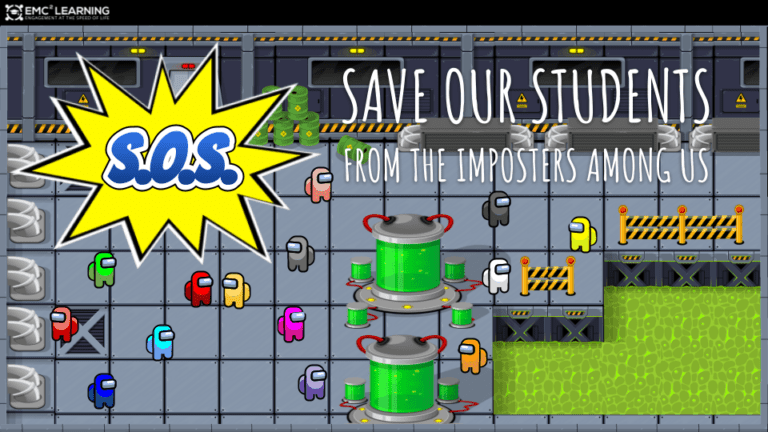
I’ve always been fascinated by games built around hidden information, suspicion, and the simple question of who can you trust? Inspired by the social deduction of Among Us, Save Our Students brings that tension into the classroom by dropping secret saboteurs into an otherwise collaborative learning experience.
What makes this one especially useful for me is that the game can sit on top of work you already planned. Students still have assignments to complete and problems to solve, but now there’s something else happening beneath the surface. Someone in the room may be working against them, and figuring out who adds an entirely different layer to the experience.
I grew up playing Mario Kart, and Track Attack takes some of what makes those races so much fun and brings it into classroom review. Teams compete their way around the track, making strategic moves and dealing with unexpected twists while trying to put themselves in position to cross the finish line first.
For me, the magic is in the constantly shifting race. Getting ahead doesn’t mean you’re staying there, and falling behind doesn’t mean you’re finished. Strategy, content knowledge, and a little luck keep everyone watching what happens next, which is exactly the kind of energy I want from a whole-class review game.