
This past weekend, a video started making the rounds on Twitter.
A teacher is leading a lesson on the Industrial Revolution. But instead of a traditional lecture or documentary, there’s something different on the screen behind them: a live walkthrough of Assassin’s Creed—a game set during that same time period.
They move through crowded streets, factories, and city blocks, using the game world as a visual anchor while explaining key ideas.
And right on cue, the discourse followed. Some people loved it. Others tore it apart.
As the old saying goes: “the knives came out.”
A teacher showed up at school with a PlayStation 5 and started playing Assassin’s Creed to explain the Industrial Revolution. pic.twitter.com/857tnaTZSj
— The Figen (@TheFigen_) March 22, 2026
Let’s Start Here: The Game Isn’t the Problem
Before anything else, we should acknowledge this:
The Assassin’s Creed franchise is known for its attention to historical detail. These worlds are researched, modeled, and built to reflect real architecture, environments, and context.
That matters.
For students, seeing a world like that—rather than a flat image in a textbook—can help make abstract ideas more concrete.
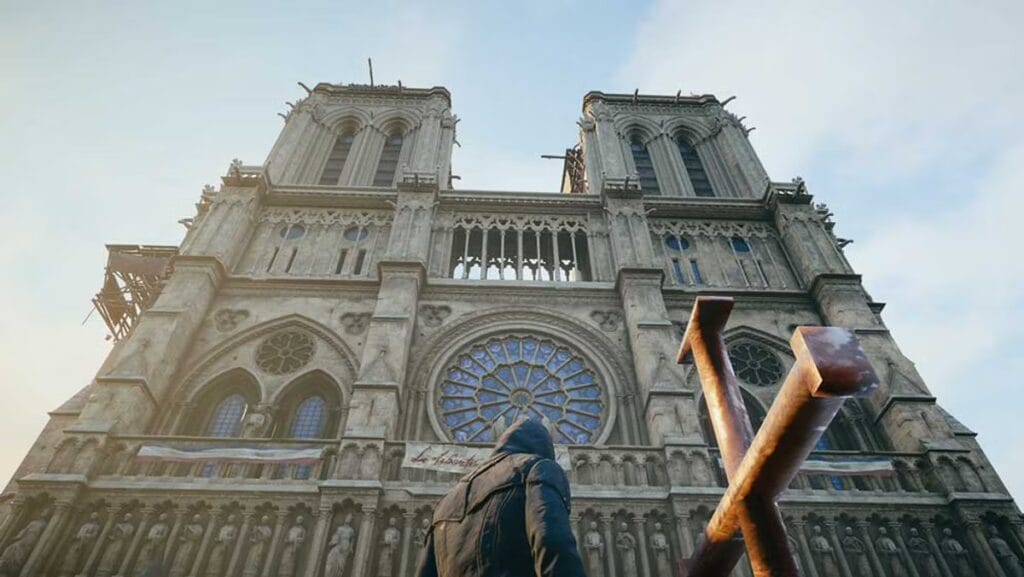
You may have even heard the story that when the Notre Dame Cathedral caught fire, restoration teams turned to Assassin’s Creed for reference. That claim has been debated (and more or less debunked) but the fact that it spread so widely and so easily tells us something. These worlds are detailed enough that the story feels true.
And that’s the point.
What students are seeing isn’t just entertainment. It’s a carefully constructed version of a historical world.
So no—the presence of a video game in a classroom isn’t the issue (after all, if the story was about a teacher simply showing a PBS style Ken Burns documentary video of the Industrial Revolution, no one would have batted an eye).
But here’s the catch.
What we’re seeing in this video isn’t really game-based learning. It’s direct instruction with a more interesting backdrop. And that distinction matters.
Because in the Science of Learning, the question isn’t:
Is this engaging?
It’s:
What is the learner actually doing?
If students are watching a teacher talk—whether that’s:
a lecture
a video
or a live game walkthrough
…the task hasn’t changed.
They’re still taking in information and trying to make sense of it in real time. And that approach comes with limits.
Research has consistently shown that all of the stuff we can store in our working memory is finite. Attention is fragile. And when we layer visuals on top of narration without changing the task? We can actually make things harder, not easier. More input doesn’t automatically lead to more learning.
A Quick Note on Cognitive Load
If we’re going to talk about the Science of Learning, we should name what’s happening in the brain.
Work from John Sweller breaks cognitive load into three types:
Intrinsic load — how complex the content is
Extraneous load — how the content is presented
Germane load — the mental work of making meaning
Teachers don’t have much control over intrinsic load. Some ideas are just harder than others. “In 1492, Columbus sailed the ocean blue.” Easy peasy. “The Industrial Revolution?” Much trickier.
But extraneous load? That’s on us.
And this is where the conversation often goes sideways.
A video game can create extraneous load.
A lecture can create extraneous load.
A worksheet can create extraneous load.
The issue isn’t the tool. It’s whether the design adds noise or supports thinking. If students are doing the same task while processing more input, we risk overload.
But.
If the task changes—if students are asked to think, decide, connect, and apply—then we’re increasing the kind of effort that actually builds understanding. And this is where some clever pedagogy (or some handy instructional tech) can really help us do the heavy lifting.
With apologies to Metallica, it’s time that we…
“Enter SAMR”
(I always wanted to say that!)
Adding Depth, Not Distraction
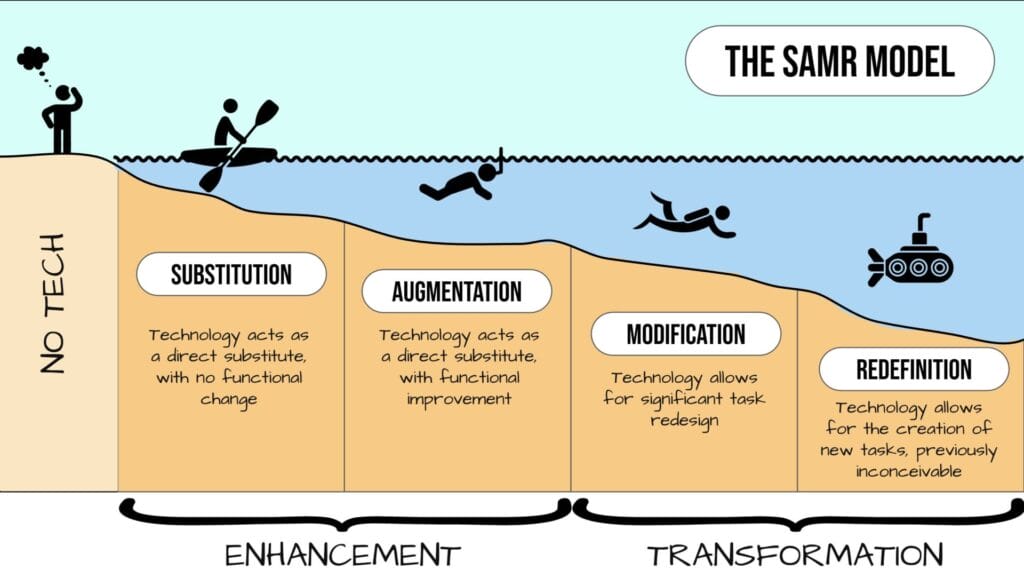
A simple way to think about this is through the SAMR Model, developed by former Harvard teaching fellow Dr. Ruben Puentedura. At its core, it asks: Does the technology change the task? And it neatly spells out four distinct tiers of possibilities that can unfold in our lessons as a result of tech integration.
Substitution — same task, new tool
Augmentation — same task, slight upgrade
Modification — task redesign
Redefinition — new kinds of learning
What we’re seeing in the Industrial Revolution video? Substitution.
No shade. But it’s a lecture—with better visuals. Or, if the teacher is occasionally stepping back to stop his gameplay and ask clarifying questions and check for understanding as he walks through the video game world (a start-stop mechanic that a traditional video could never have accomplished)? Maaaaaaaaybe “Augmentation,” at best.
That’s not automatically bad. But it’s also not what people are talking about when they point to the potential of games in learning.
But the value of something like Assassin’s Creed isn’t in watching it. It’s in using it.
If students are:
predicting what they’ll encounter
stopping to analyze what they see
debating cause and effect
navigating with a purpose
now the task changes. Now they’re doing something with the content. That’s where things start to stick. And before you know it? That extrinsic cognitive load is a whole lot lighter.
A lot of the pushback online lands in a similar place: “this is why gamification doesn’t work.” And it’s easy to understand the instinct, as there are plenty of examples out there that are flashy, shallow, and more distracting than helpful, and those are absolutely worth critiquing (we literally wrote an entire chapter about this in the new book!).
But that’s not really what’s happening here. This is a teacher using a tool in a way that doesn’t change the task, and then having that labeled as something it isn’t. When we start from that kind of mislabel, it becomes difficult to have a productive conversation about what actually works.
So How Could we Use Games (and Tech!) to Level Up this Lesson?
Take the same idea—helping students visualize the Industrial Revolution—and make one small change: change the task.
Instead of watching a walkthrough, students could be asked to build a scene themselves using whatever materials you have on hand—LEGO bricks, paper, simple supplies. Now they have to make decisions about what belongs, what matters most, and how different elements connect. And they can’t just wing it—they need to pull from something. Notes, a short reading, a reference sheet. The content doesn’t change, but what they’re doing with it does.
That’s the shift.
Students are retrieving information, organizing it, and applying it in a way that forces them to think about how it all fits together.
If you want to see what this can look like at another level (yay educational technology!) take a look at the short clip above from a 10th grade class I was working with that built their own virtual worlds in Minecraft after reading Dante’s Inferno. Students designed and narrated their worlds, walking viewers through each level step by step—citing text evidence, explaining choices, and making connections along the way. It’s the same idea, just with a different tool.
And that’s kind of the point. The possibilities aren’t limited by the tool—they’re opened up by the task.
In the end?
There’s a teacher in the original video trying something different, and that’s worth acknowledging. But the bigger takeaway here isn’t about games versus no games. It’s about the work we ask students to do. When the task changes, the thinking changes. And that’s where the learning starts to stick.
The approaches explored in this blog post are just a handful of the 1100+ resources available and on their way to arrive shortly in the EMC² Learning library. This entire library is available to all members with an active Engagement Engineer or Engagement Engineer PLUS account, and is included with your annual site membership. We hope you’ll consider joining us as an Engagement Engineer to unlock a full year of site access. For complete details including our exclusive limited time offer for annual site membership, click here.