
Hey all! A very sore, and very humbled John here. Reporting to you LIVE on the heels of this year’s ISTE + ASCD Conference in Orlando, Florida (more on the “heel” part in a second).
On the flight to this year’s conference, I finally had the chance to finish reading Make It Stick: The Science of Successful Learning by Peter C. Brown, Henry L. Roediger III, and Mark A. McDaniel. I had heard people recommend it for years, but it remained one of those books I fully intended to read someday while continuing to push it off. But March of this year saw me step into a new full-time staff development teacher role in a school who’s committing to a massive County-wide training effort behind the Science of Learning (cognitive load theory! Huzzah!), and so I finally ran out of most of my excuses to keep kicking the can down the road. By the time we landed, I had finished the book and filled it with enough notes and folded corners to make up for lost time.
One of its central ideas stayed with me as I walked off the plane: humans are spectacularly poor judges of our own learning (case in point: ask a room full of people whether they’re an above-average driver. What are the odds, right?!). We trust our instincts far more than we should. The strategies that feel smooth and productive are not always the ones helping us remember. Meanwhile, the strategies that feel slower, harder, and occasionally frustrating often produce learning that lasts. What feels effective in the moment can be a terrible measure of what will actually stick. Conversely, those moments of productive struggle or frustration can be some of the clearest signs that learning is happening after all.
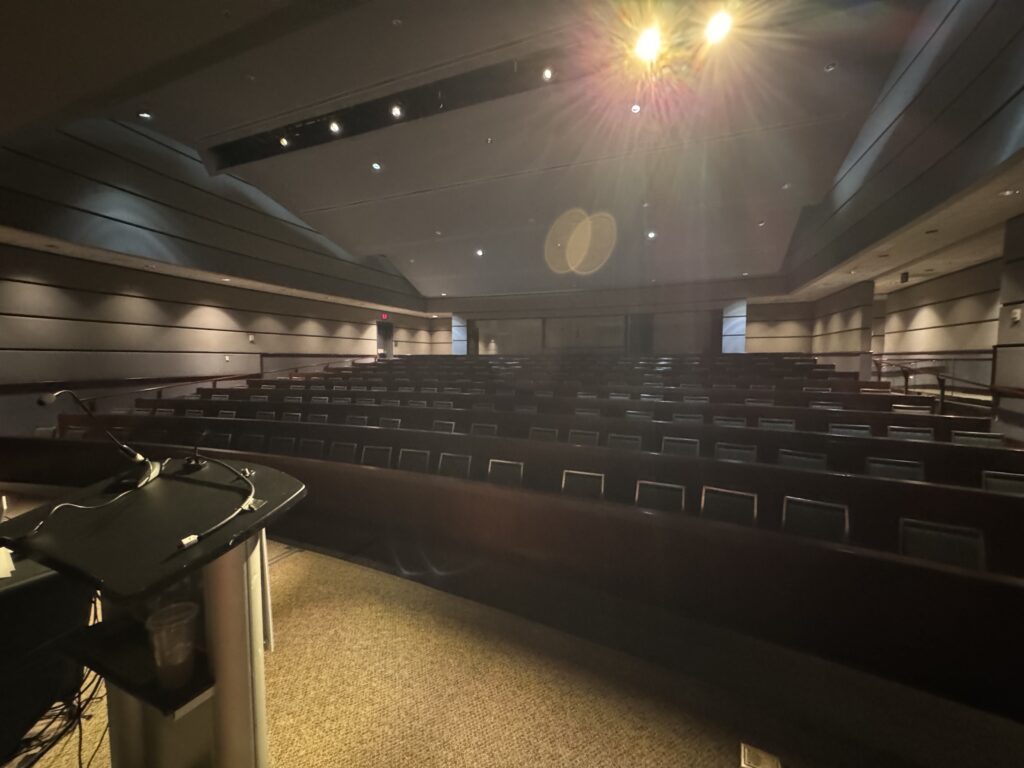
But where was I? Oh right. Just about to step onto a massive presentation stage in Orlando.
Naturally, I couldn’t help thinking about how everything I’d been reading might apply to the work we do as students and teachers. Here I was at ISTE + ASCD talking about classroom engagement, modern games, and instructional design, and the connections were impossible to ignore. How often do we mistake quick answers for understanding? How often do students interpret difficulty as evidence that they’re failing when it may actually be evidence that their brains are doing the work? I had plenty to think about before I ever stepped onto the stage.
Then I stepped right off one.
Now, in my defense… conference stages can be strange places. The presenter stands beneath blinding lights while most of the audience disappears into darkness, making the front edge surprisingly difficult to see once you start moving around. During my session, I was explaining how great games teach players through rapid cycles of play, feedback, and iteration rather than burying them beneath pages of instructions. I took one more step and… well… I’ll let this super short video do the talking. The conference livestream captured the whole thing. LET’S GO TO THE VIDEO TAPE!!!
The laughter came quickly once everyone realized I wasn’t seriously hurt (author’s note: I think?). I laughed too, cracked a quick joke (and maybe let one well-earned curse word slip), climbed back onto the stage, and kept going. In the moment, adrenaline handled most of the consequences. Flash forward a few weeks later (complete with a newfound prescription of lots of PT and some much-needed pain meds!) my upper back has been handling the rest.
But that’s another story.

Since returning from the conference, those few seconds became my single memory of the session. I could replay the exact step, the sudden drop, the landing, and the scramble back onto the platform. I wondered how ridiculous it looked from the audience and assumed it must have become the story people told afterward. Never mind everything else we covered during the hour; in my version of events, I had delivered a keynote on falling down.
Then I opened the session feedback. Teachers wrote about the activities they planned to try, the ideas they wanted to share with colleagues, and the ways they were reconsidering the opening minutes of a lesson or unit. They mentioned engagement, relevance, classroom application, and the relief of attending a session that offered useful ideas without turning into a sales pitch. Dozens of people described what they had learned and what they planned to do with it.
The fall was not mentioned once.
That sent me back to Make It Stick, although not quite in the way I expected. Brown, Roediger, and McDaniel argue that we are poor judges of our own learning. And by the same token, I guess it only makes sense that presenters (and teachers?) would be just as spectacularly bad judges of our own teaching, too. We experience every missed cue, muddled direction, clumsy transition, and near-death-tumble-off-a-stage (ok. That last one might be a slight exaggeration) that made considerably more sense during our dry run. Because we feel those moments from the inside, we assume everyone else experiences them with the same intensity.
They usually do not. Students are busy having their own version of the lesson, one shaped by the question that interested them, the conversation with a partner, the challenge they finally solved, or the comment that made an idea click. Thankfully for us, the human brain is pretty gosh darn resilient (unlike my upper lumbar region). And so every mistake we replay on the drive home may barely register for them. Meanwhile, something we considered incidental may be the exact thing they remember months later.
None of this means our judgment is useless or that we should stop reflecting on our work. Quite the opposite. Reflection matters. So does rehearsal. So does striving to improve. It simply means that the view from the front of the classroom is incomplete. The lesson we believe we taught and the lesson students actually experienced are related, but they’re never perfectly identical. That’s precisely why feedback matters. It fills in the gaps our own perspective can never fully see.
So what’s the moral to this story?
Humans are spectacularly poor judges when it comes to our own behaviors. So don’t be afraid to ask your students. Read those surveys. Look at those exit tickets. Listen to those conversation that happens on the way out the door. You may discover that the moment you’ve been replaying in your head for days barely registered with anyone else. Meanwhile, the learning you worried wasn’t happening may have quietly taken root all along.
Turns out, there are worse things to stick than a landing.
The activities featured in EMC² Learning presentations and workshops are just a handful of the 1,100+ resources available and on their way to arrive shortly in the EMC² Learning library. This entire library is available to all members with an active Engagement Engineer or Engagement Engineer PLUS account, and is included with your annual site membership. We hope you’ll consider joining us as an Engagement Engineer to unlock a full year of site access. For complete details including our exclusive limited time offer for annual site membership, click here.