

Hi folks! John here.
Every summer, there are a handful of conferences that Michael and I circle on the calendar months in advance. They’re the events where we know we’ll reconnect with old friends, meet incredible educators doing inspiring work, and leave feeling every bit as energized as the people we’re fortunate enough to work alongside. The Keystone Technology Innovators Summit—better known as KTI—has become one of those places.
This year marked my fifth opportunity to keynote the event since first walking onto the KTI stage back in 2019. A lot has changed since then. Three books have found their way into the world. EMC² Learning has grown from an idea into a community of thousands of educators. I’ve become a dad. Artificial intelligence has fundamentally changed the conversation around teaching and learning. Through all of it, KTI has remained one of those rare places that never loses sight of why educators gather in the first place: not simply to collect ideas, but to become better at the craft together.
The theme of this year’s keynote was The Game Has Changed, and I meant that quite literally.
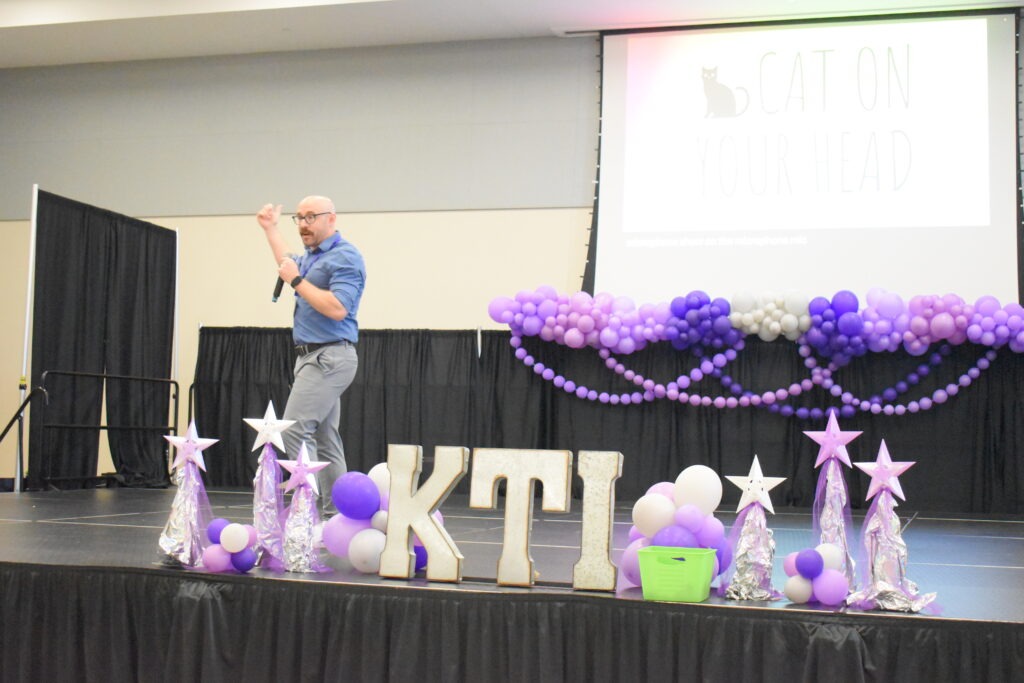
The world our students are preparing to enter looks dramatically different than it did even a few years ago. AI can generate essays, solve equations, produce artwork, write code, and answer questions that once required hours of research. Employers continue to place increasing value on creativity, collaboration, adaptability, communication, and problem solving alongside traditional academic knowledge. If those are the skills our students need, then simply asking them to memorize more information isn’t going to be enough. We have to create classrooms where those skills are actually practiced every day—not just discussed.
That’s easy enough to say. It’s much harder to model.
Professional development has a funny habit of asking teachers to create learning experiences that participants never actually experience themselves. We encourage collaboration while seating everyone in rows. We preach engagement through sixty-slide PowerPoints. We talk about student agency while tightly controlling every minute of the agenda. By the end of the day, we’re asking educators to imagine what meaningful learning could look like without ever giving them the chance to feel it.
So this year, we tried something different.
Rather than spending the morning talking about playful pedagogy, we spent the morning living it.
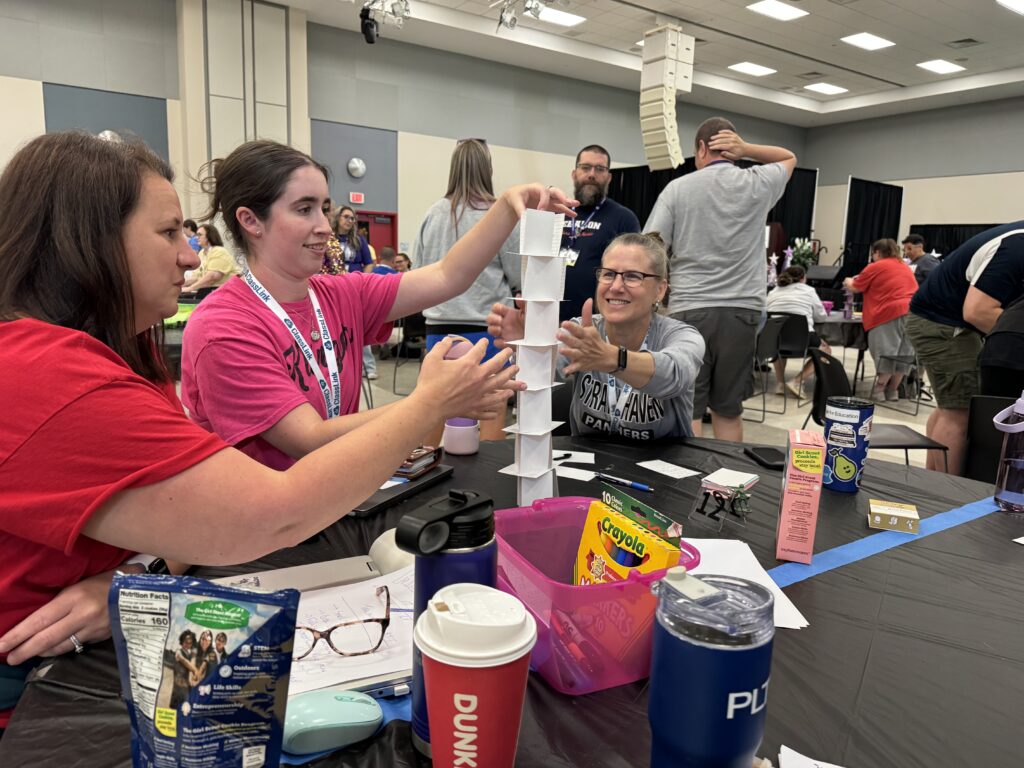
From the opening activity onward, participants became learners instead of audience members. They solved problems with people they’d met only moments before. They debated strategies. They revised ideas. They laughed—a lot. They failed safely, adjusted, and tried again. Every challenge was designed around the same question: What small design choices make people want to participate? By lunchtime, the room wasn’t quietly taking notes. It was buzzing with conversation.
One activity in particular seemed to capture the spirit of the day. We introduced everyone to Cat on Yer Head, a wonderfully ridiculous cooperative game that asks players to move cats, mice, and cheese around a room while following an intentionally quirky set of rules. On its face, it’s exactly the sort of thing that makes people laugh and wonder where on earth this presentation is headed.
That uncertainty is intentional.
After everyone has experienced the activity, we stop playing and start thinking like designers. Which rule increased participation? Which one unintentionally excluded people? What happened when we added another objective? How could this become a vocabulary review? A math lesson? A science lab? A discussion protocol? Suddenly, what began as a silly game transforms into a conversation about instructional design. Participants aren’t asking where to download the activity. They’re imagining how to rebuild it for their own students.
That’s the shift we’re after.
One of the ideas we returned to throughout the keynote is that teachers don’t need another thousand classroom activities. They need a better understanding of the design principles that make activities work in the first place. Once you understand concepts like meaningful decisions, continuous participation, evolving difficulty, student agency, and iterative improvement, you stop relying on someone else’s templates. You begin creating experiences that fit your own learners, your own curriculum, and your own classroom.
That’s a much more powerful kind of professional learning.
Day 3 What new skill or strategy do you want to develop?
— Keystones (@keystonespa) July 29, 2026
Thanks to IPEVO for the mic!!! @ipevo pic.twitter.com/cJPSwt4GYs
The afternoon built on that same philosophy. Instead of treating engagement as something reserved for “fun Fridays” or end-of-unit review games, we explored how the same design thinking can reshape everyday instruction. Teachers worked through collaborative design challenges, experimented with new discussion structures, reimagined familiar instructional routines, and spent time iterating on ideas with colleagues who taught completely different subjects and grade levels. Watching an elementary teacher swap ideas with a high school science teacher—or a technology coach build on the thinking of an English teacher—is one of my favorite parts of KTI every single year.
That cross-pollination is where innovation actually happens.
By the end of the afternoon, there wasn’t a single “right answer” floating around the room. There were dozens. Every table had taken the same ideas in a slightly different direction, which was exactly the point. Great teaching isn’t about copying someone else’s lesson. It’s about adapting strong ideas until they become uniquely your own.
The feedback reflected that philosophy far better than any statistic ever could.
One educator wrote simply, “PD that didn’t feel like PD.”
Another shared that the session was “fast paced, engaging, and full of ideas to use in class right away.”
Several others mentioned leaving with strategies they planned to implement immediately, while many commented on how refreshing it was to spend the day actively participating rather than passively listening. Of course, we’re incredibly grateful that every attendee found the experience valuable, but the comments themselves tell the real story. People weren’t excited because they collected another folder full of resources. They were excited because they had experienced the kind of learning they want their own students to have.
That’s why KTI continues to mean so much to us.
Every year, we’re reminded that professional development doesn’t have to be something educators survive. It can be joyful. It can be intellectually challenging. It can be playful without sacrificing rigor. It can respect teachers as professionals by giving them opportunities to think, experiment, debate, redesign, and create alongside one another. In many ways, KTI feels less like a conference and more like a summer camp for people who genuinely love the craft of teaching.
To the entire KTI family, thank you for welcoming us back once again. Thank you for embracing every challenge, every conversation, every ridiculous cat-related activity, and every opportunity to ask, “How could we make this even better?” Most of all, thank you for continuing to prove that the future of education won’t be built by educators who are afraid to try something new. It’ll be built by teachers who are willing to play, to iterate, and to keep learning right alongside their students.
Here’s to another year of “Purple Reign!” And if this year’s energy was any indication, the best is still yet to come.
The activities featured in EMC² Learning presentations and workshops are just a handful of the 1,100+ resources available and on their way to arrive shortly in the EMC² Learning library. This entire library is available to all members with an active Engagement Engineer or Engagement Engineer PLUS account, and is included with your annual site membership. We hope you’ll consider joining us as an Engagement Engineer to unlock a full year of site access. For complete details including our exclusive limited time offer for annual site membership, click here.