
“We HAVE to score it.”
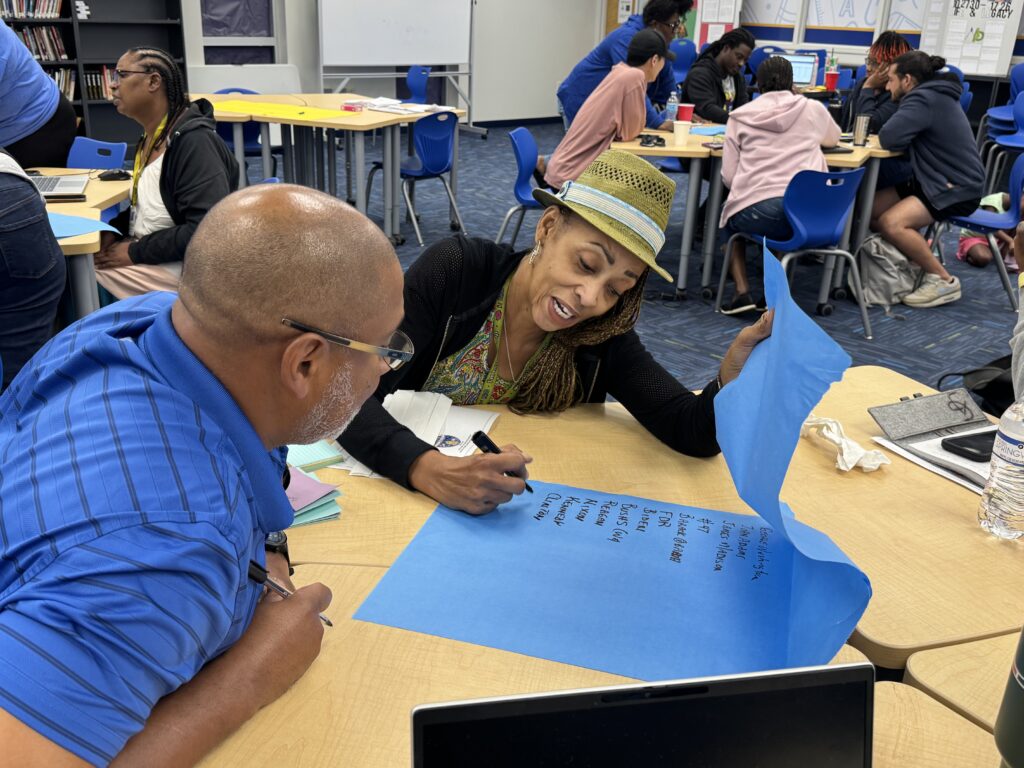
Hey all. John here. And I wanted to lead with that quote because it’s the response that Michael and I get literally EV.ER.Y. TIME. that we finish Big Sheet Keepaway — one of our go-to training activities when working with rooms full of teachers who are looking to bring a bit of playfulness to their instructional playbook. At its heart, the activity is basically just a big old brain dump on oversized chart paper with a clever bit of good-natured team-against-team idea stealing thrown in for good measure. But at the end of the Big Sheet Keepaway, we give teachers a choice: we can take a few minutes to tally everything up and see who won, or we can skip the scoring and move on with the session.
To date, we’ve never once encountered a team who’s wanted to skip it.
Scoring takes time, and everyone in the room knows it. There is always more we could be doing, more we could be discussing, and more we want to get to before the session ends. The points themselves do not really matter, but once people are invested in something, they want to know how it ends.
What we’re seeing in those moments is something pretty close to what the experts call the “Flow State.” People are focused, invested, and caught up enough in what they’re doing that moving on actually feels like an interruption. The game has their attention, but the learning is still happening right alongside it. And if a room full of adults can get that absorbed in a professional learning activity, it’s hard not to wonder what becomes possible when we create those same conditions for students.
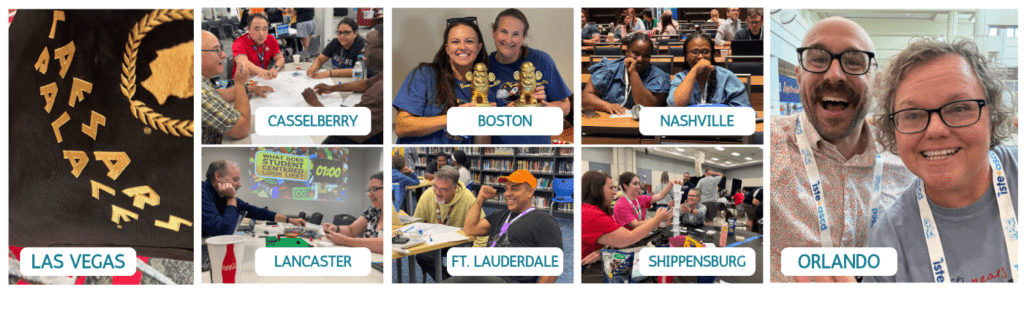
Again and again (and again and again!), that same question followed us around all summer. Las Vegas. Nashville. Boston. Back-to-back dates in Lancaster and Shippensburg, Pennsylvania. And a triple shot in the Sunshine State with stops in Fort Lauderdale, Orlando, and Casselberry, Florida.
Over the past eight weeks, Michael and I traveled to eight different cities for conferences, keynotes, presentations, and full-day workshops, working with thousands of educators along the way. The audiences changed from place to place, but we kept seeing versions of the same thing: teachers laughing, concentrating, competing, collaborating, and getting caught up in the work.
The feedback reflected that too. Teachers told us they appreciated being able to laugh during professional development without feeling like the learning had somehow become less serious. They talked about leaving with ideas they could actually picture using in their classrooms, rather than a collection of notes they might never revisit. Again and again, people told us they felt energized by the experience and excited to try something different with students.
We are obviously grateful for that feedback, but the more useful question is what those reactions tell us about learning. If adults respond this strongly to chances to play, collaborate, make decisions, compete, revise, and actually do something with what they are learning, that is worth remembering when we bring those same techniques back to our students.
For us, that may be the clearest takeaway from the summer. If we can have this much fun while still thinking hard, reflecting, solving problems, and learning something useful, there is no reason those things should feel separate in our classrooms. Play does not have to mean fluff, and rigor does not have to mean joyless. The strongest moments were often the ones when people stopped thinking about whether something was “fun” or “serious” because they were too busy being part of it.
At the same time, the summer did not leave us feeling like we had everything figured out. Every group we worked with brought different questions, adaptations, frustrations, and ideas to the table, and some of the most useful learning happened when teachers pushed on something we had presented, changed it, or helped us see it differently. That is a big part of why Michael and I keep coming back to reflection after these events rather than treating the work as finished once the room clears out.
In a lot of ways, I guess you could say that blog posts like this one are our own version of keeping score. Michael are not trying to tally cities, sessions, miles, or applause. We are trying to stop long enough to ask what was worth carrying forward before another school year gets moving. We did some of that work during our summer planning retreat as well, looking back at what we heard and saw on the road and thinking about what it means for the next round of resources and ideas we build together.
But what keeps coming back to us is pretty simple: people want to care about what they are doing, and they want learning experiences that give them a reason to stay invested. Sometimes that comes through competition, sometimes through collaboration, sometimes through making or solving something, and sometimes through a conversation that takes an unexpected turn.
And sometimes it means a room full of teachers refusing to let us move on until somebody counts the points.
So we score it, we figure out who won, and then we talk about why everybody cared so much in the first place. And that’s… kind of the point in the end. Because in the end? Whether you’re talking about traditional grades or oversized charting activities with ridiculous rule sets, we’re all kind of in on the joke that these games are made up and the points don’t matter. But when we build the parameters juuuuuuuuust right, you certainly wouldn’t know it once you’re in the thick of all the action.
As you head back into your own classroom this year, we invite you to look for opportunities to create more of those moments: learning experiences your students want to finish, questions they want to keep chasing, and work they care enough about to see through to the end. That’s the work we’re committed to on this end, and the work we’ll be sharing here on the blog and in every one of the trainings, resources, and presentations we provide in the year to come.