

“Train hard. Say your prayers. Eat your vitamins. Believe in yourself.”
– Hulk Hogan
Hey folks. John here. I’ll let you in on a nerdy little secret.
Long before I ever stepped into a classroom, I believed in the power of performance. Of presence. Of larger-than-life superheroes.
Because before I ever wanted to be a teacher — I was a diehard fan of professional wrestling.
And no one taught me more about how to stand tall, show up, and create a moment that matters than “The Immortal” Hulk Hogan.
Growing up in the 1980s, Hulkster wasn’t just a wrestler. He was a walking cartoon character with real muscles. He was Superman without the cape. The Real American. The guy who could lift a 500-pound giant, rally a crowd with nothing more than a cupped ear, and inspire a legion of kids like me to believe that good would always triumph over evil — as long as you said your prayers, ate your vitamins, and stayed true to your friends
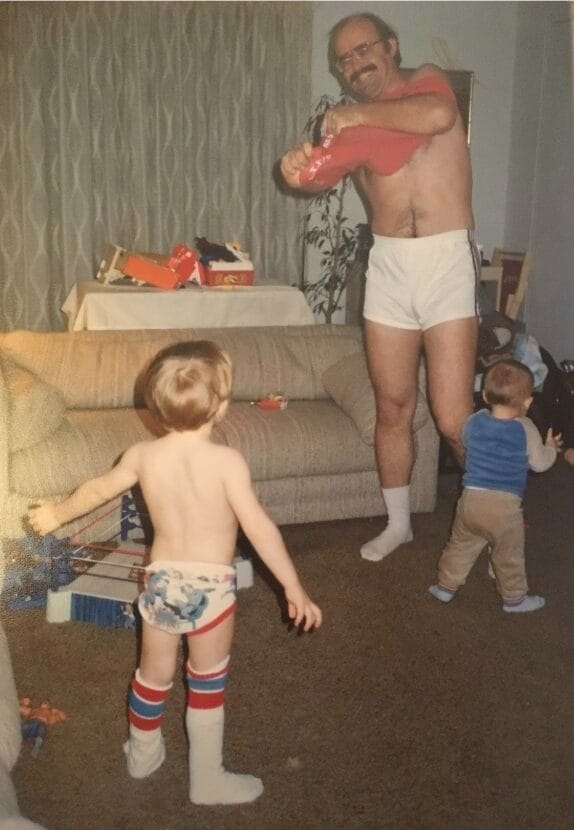
Piscataway, New Jersey, circa 1986. I’m the four-year-old Iron Sheik in the underoos, while my Dad transforms into the shirt-ripping Immortal Hulk Hogan, as my brother Jeremy and our beloved LJN Wrestling Superstars action figures watch close by.
In our house, the living room was the arena. My brothers and I would spend hours bouncing off piles of couch cushions, pretending to throw punches and drop elbows in epic title matches of our own invention. Sometimes, my dad would join in — transforming, right before our eyes, into the Immortal Hulk Hogan. He’d flex. He’d growl. He’d rip off an invisible shirt to the cheers of his three pint-sized fans.
And in those moments, we believed. Because that’s what the best heroes are meant to do.
They make us believe.
Over the years, the lines between fantasy and reality got blurrier. Wrestling got edgier, and the once-wholesome “Hulk Hogan” became the nefarious “Hollywood Hogan,” leader of a super stable of wrestling baddies known as the “new World order” (or “nWo” for short). And eventually, the man behind the mustache — Terry Bollea — was revealed to be far more complicated than the myth he created. His legacy, like all legacies, is a mixture of triumphs, contradictions, and controversy.
But if you’re only looking at the headlines, you miss the real magic.
You miss the way he showed up for the kids.
The way he rolled with the punches when a six-year-old fan approached him in full-on kayfabe (that’s rasslin’-speak for “staying in character”), calling him out with a serious challenge — and Hogan, instead of brushing him off, threw up the big pose and cut one of his trademark promos right there on the spot. You miss the hundreds of Make-A-Wish kids he visited, where he took the time to remind them that they, too, were champions. You miss the story from just last year, when Hulk — now in his 70s — pulling over to the side of a Tampa highway to help lift a car door off its hinges and rescue a trapped 17-year-old driver after a nighttime crash.
Not because he had to.
Because that’s what heroes do.
As the years passed, it became increasingly difficult to draw the line where the performer ended and the performance began. Plagued by controversies in his later years, the unrelenting tabloids were all too quick to draw painful attention to the fact that Terry Bollea was human — flawed, fallible, and often his own worst enemy. But in the eye of so many of the children who looked up to him for all those years, “Hulk Hogan” was something else entirely. And while we can all strive to live better, more honest lives than the imperfect man behind the character, perhaps we could also do a whole lot worse than to be remembered as fondly as the exaggerated hero he became to millions.
Because in many ways, that’s what teachers are too.
We may not have action figures or catchphrases. But we show up. We check our hard days at the door and hold space. We tell stories that stick. We work the crowd into a frenzy, try to be the sort of role model who can be unequivocally “good” and worth rooting for, and help play a small part in childhood stories they’ll remember for the rest of their lives.
And sometimes — if we do our jobs just right — we leave behind a memory that outlives the moment.

New York City, 2019. The gear. The glory. The gold. On display at the world’s most famous arena of Madison Square Garden — Hulk Hogan’s iconic WrestleMania-era look that defined a generation.
Just yesterday, I felt that ripple effect firsthand.
The news of Hulk Hogan’s passing didn’t come to me through a wrestling site or breaking alert. It came through a quiet ping in our family group chat — a message from my cousin Marianna.
Now, Marianna is not a wrestling fan. Never was. She’s a personal trainer now, nearing 50. But she grew up right alongside my brothers and me, spending weekends at our grandma’s house, watching — and hearing — the chaos we brought with us. Piledriving couch cushions. Imitating ring announcers. Pretending to be heroes in trunks and tube socks.
So when she heard the news, she didn’t think of tabloids or title matches.
She thought of us.
Of our joy. Of those moments. Of him.
That’s what real icons do.
They leave echoes.
The best teachers — the immortal ones — do the same.
They may never know the full impact of their work. They may never see 90,000 fans screaming at the top of their lungs over the success of their latest classroom activity. And they may never hear how a quiet comment changed a life, or how a single lesson became a core memory for one of the little “Teach-a-maniacs” sitting in their front row. But their students will remember.
And if we’re lucky? In twenty, thirty, forty years, someone will say your name the way Marianna said his:
“I thought of you immediately.”
That’s the power of presence. That’s the legacy of real-life superheroes.
And that’s why what we do in classrooms matters — not just today, but forever.
We hope you’ll consider joining us as an Engagement Engineer to unlock a full year of site access. For complete details including our exclusive limited time offer for annual site membership, click here