Hey all. John here.
Last year, Murph taught me something about community.
I wrote about crossing the finish line with a few others after we collectively decided nobody was going to tackle that final hill alone. Looking back, I’m still proud of that piece and the lesson it carried. Showing up matters. Effort matters. We don’t leave people behind.
This year, however, I came home thinking about something entirely different.
Twenty pounds.
More specifically, a weighted vest.
For those unfamiliar, “Murph” is a CrossFit Hero Workout completed each Memorial Day in honor of Lieutenant Michael Murphy, a Navy SEAL who was killed during Operation Red Wings in Afghanistan in 2005. The workout itself is simple enough to explain. Folks who knew him say that “Murph” himself used to do it regularly — while wearing his standard issue body armor: a one-mile run, 100 pull-ups, 200 push-ups, 300 air squats, and a final mile run to finish. It’s a workout completed in memory of a man whose courage and sacrifice are difficult to comprehend and impossible to adequately repay.
Like many people, I use Murph as an opportunity to reflect. There’s something about an hour spent running and counting repetitions that creates a lot of space for thinking.
This year, I decided to wear the vest. Not because I thought it would make me tougher or faster. I wore it because I wanted to experience the workout differently.
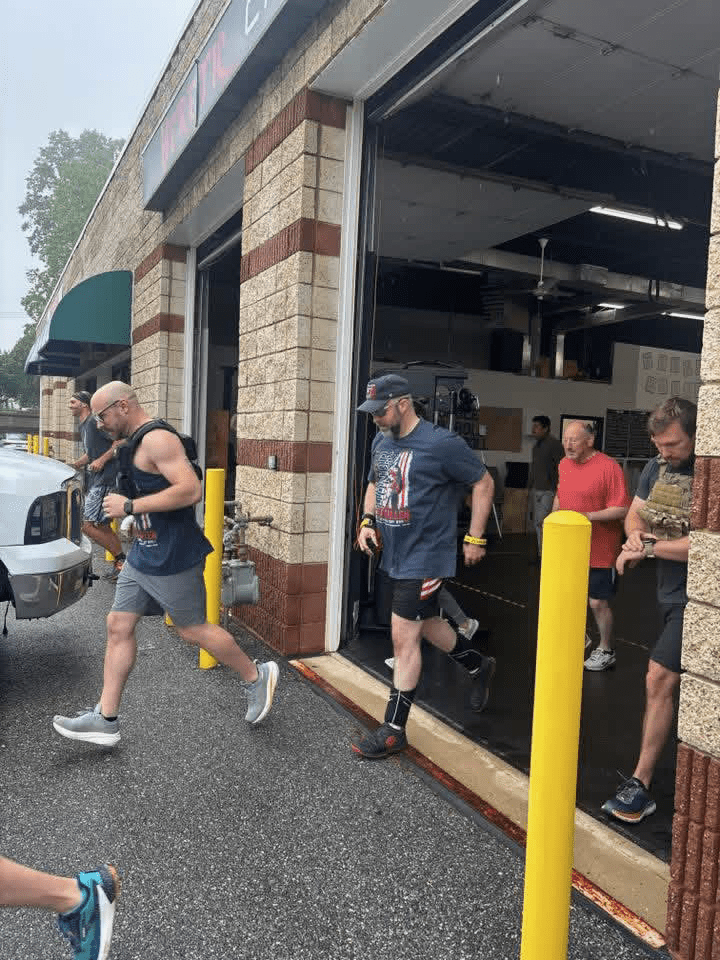
The strange thing is that the vest didn’t change Murph in the way I expected. To be clear, everything was harder. The pull-ups were the obvious first thing to go, but I was blown away by how much twenty extra pounds affected everything else. I’ve done plenty of running over the years, yet my ankles were searing before I even reached the halfway point of the first mile. The push-ups were miserable (my shoulders spent the next several days reminding me of that fact). The squats felt heavier. Every movement carried a little more consequence. None of that was surprising.
What surprised me was that the weight didn’t just make the workout harder. It made the workout harder to ignore.
I’ve done Murph twice before. And in the 365 days since my last attempt, I’ve done countless pull-ups, push-ups, and squats. I’ve been doing CrossFit long enough that many workouts have a familiar rhythm to them. After a while, you kind of… settle in. You find your pace. Your mind wanders. You think about work (presentations! lesson plans!). You think about family. You think about the errands waiting for you later that afternoon. Before you know it, you’ve completed a workout while mentally spending half of it somewhere else.
The vest didn’t allow that.
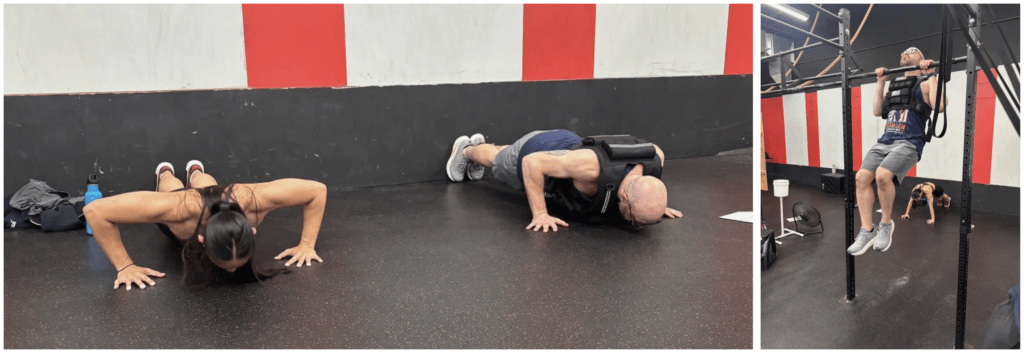
Somewhere around the middle of the workout, I found myself laughing at how absurdly small I had made my partitioning. Rather than tackling Murph in larger chunks, I had settled into a rhythm of two pull-ups, four push-ups, and six squats before starting over. On paper, it sounds ridiculous. Yet the moment I stopped worrying about the entire workout, I became far more successful at managing the workout itself. One hundred pull-ups is intimidating. Two pull-ups isn’t. Three hundred squats is intimidating. Six squats isn’t. The challenge never disappeared, but it became small enough to focus on without feeling overwhelmed by everything that still remained.
And to be clear, this wasn’t some master strategy that suddenly made the workout easy. Somewhere around the 45-minute mark, I was still only about two-thirds of the way through the pull-ups, push-ups, and squats, and I knew there was a strong likelihood that I simply wasn’t going to finish the workout as prescribed. Our gym cuts athletes off at the 60-minute mark if they haven’t started the final mile, and I could do the math. The vest had slowed me down considerably. Last year, without the vest, I finished Murph in 72 minutes. This year, I wasn’t chasing a time. I was simply trying to stay present and keep moving.
As the workout wore on, I found myself thinking about something Michael and I wrote about in Playing with Purpose earlier this year. On a day dedicated to honoring fallen veterans, maybe it was fate or maybe it was dumb luck, but my mind kept returning to a passage where we discussed (of all things) that mantra made famous by the Navy SEALs: “Slow is smooth. Smooth is fast.”
Murph in a weighted vest turned out to be one of those situations where the saying suddenly made perfect sense. Every time I tried to speed things up, my movement quality suffered, and every time I looked too far ahead, I lost my rhythm. The answer wasn’t moving faster. It was about moving mindfully.
I know it sounds crazy. But it really was about staying present in the moment.
And because I spend most of my life thinking about teaching and learning, my mind eventually wandered toward the classroom. One of the things I’ve wrestled with more and more over the years is our tendency as teachers to confuse rigor with quantity. I see it in myself all the time. Audiobooks and podcasts speed-read by machine voices at 2x pace (I’m terribly guilty of this one). Judging the success of our lesson plans by the sheer number of pages we can charge through. More chapters. More assignments. More work. We often assume that more automatically means better. Yet some of the most demanding intellectual work I’ve ever watched students do involved slowing down and spending real time with a single paragraph, a single quotation, or a single idea.
The vest got me thinking about that: It didn’t make Murph meaningful simply because it made Murph harder. It made Murph meaningful because it made it harder to be mindless. It forced me to focus on the next rep instead of the hundredth rep, on quality instead of quantity, and on what was directly in front of me rather than everything that still remained.
And the more I think about it, the more I wonder how often we accidentally rob students of that same opportunity to sit with the productive struggle that we call effortful thinking.
Sometimes the most meaningful challenge isn’t the longest one. Sometimes it’s the one that forces us to slow down, pay attention, and actually notice what’s right in front of us.
Twenty pounds didn’t teach me anything revolutionary. If anything, the lesson felt embarrassingly obvious: Slow down, champ. Focus on the next rep. Do it well. Then do it again.
Maybe that’s true in the gym. Maybe it’s true in the classroom too.
2026 MURPH RESULTS
20 lb weighted vest
60-minute time cap
492 / 600 reps completed
1 / 2 miles completed
DNF