

If you’ve ever opened a new EMC² Learning resource and felt a little unsure about where to begin, fear not! Teachers consistently tell us that the single biggest challenge about our site is simply figuring out just where, exactly, it makes the most sense to start. With more than 1,100+ fully editable activities on the platform (each designed to flex across different subjects, grade levels, and teaching styles) it’s completely normal to feel a tiny bit overwhelmed the first time you dive in. Think of it like walking into the world’s best-stocked workshop: excitement everywhere… but also a lot to look at.
Here’s the good news: You don’t need to master everything. You just need to understand the flow. And we’ll walk with you every step of the way!
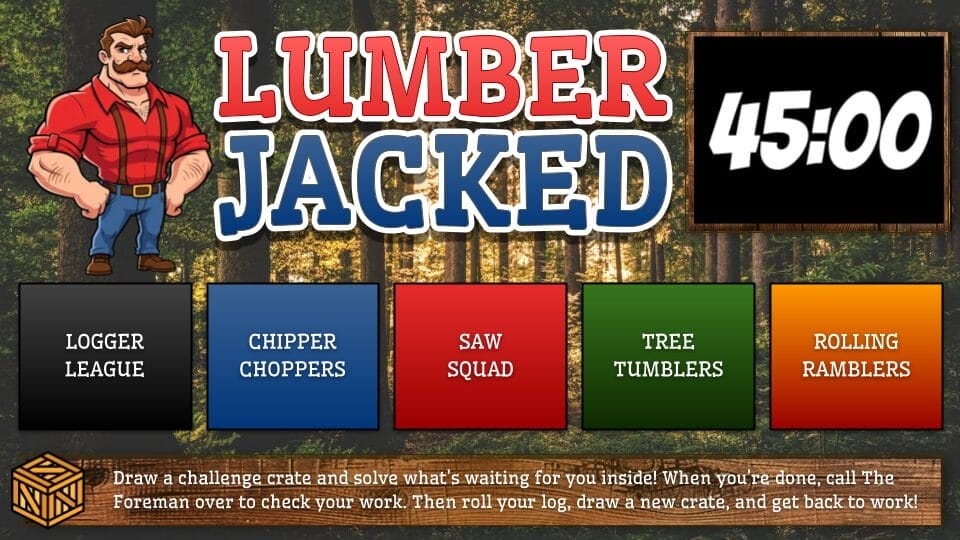
Let’s break down how most EMC² activities work, using one of our seasonal crowd favorites, Lumber Jacked, as an example.


Finding Your Flow with EMC² Learning
While every resource has its own theme and unique twists, the overall structure across many of our UDL friendly and game-inspired activities remains beautifully consistent.
1. Students typically work in small teams.
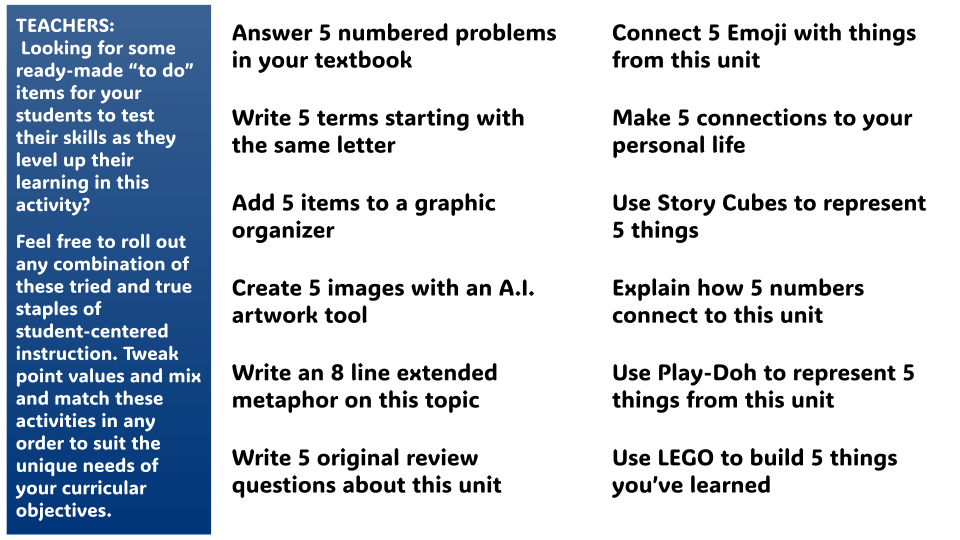
Instead of traditional worksheets like “complete problems 1–5,” EMC² tasks are intentionally open-ended, creative, and UDL-friendly, giving students multiple ways to show what they know. These activities remove common barriers that hold learners back by providing choice, flexibility, and varied representation. A single prompt can be tackled through writing, drawing, building, connecting, questioning, or storytelling — whichever pathway helps a student access the learning most effectively.
- “Make 5 connections between this unit and the last one.”
- “Draw and annotate 5 key ideas from today’s lesson.”
- “Use LEGO or Play-Doh to represent 5 concepts.”
- “Write 5 original vocabulary sentences.”
- “Create 5 higher-order questions about the topic.”
Because these tasks are endlessly repeatable and naturally differentiated, students can work at their own pace, revisit ideas as many times as they need, and choose the method of expression that fits them best. The result? Higher engagement, lower frustration, and a classroom experience intentionally designed to support every learner — straight from the spirit of Playing with Purpose.
(Which reminds us: did you hear the news about the new book!?)
2. The teacher becomes the ‘floater.’
No more running the entire show from the front of the room.
No more waiting for groups to take turns.
No more bottlenecks.
Instead, you circulate — moving beyond the old “sage on the stage” vs. “guide on the side” dichotomy to become what author and Elon University professor Anthony Weston famously refers to as “the impresario with the scenario.” The richly themed (and fully editable) Google Slides presentation does the heavy lifting by setting the stage and immersing students in the world of the activity, while you serve as a trusted mentor within it.
You move from team to team checking work, answering questions, nudging thinking forward, and offering feedback on the fly. It’s low-stress for you and high-engagement for them.
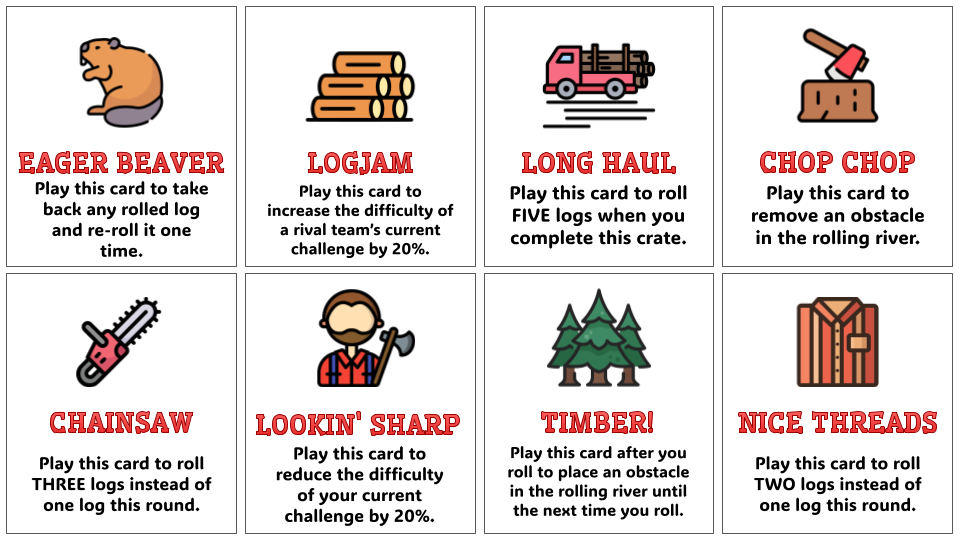
If two groups need you at once? Easy. Give one team a quick “extra” challenge to deepen their work or add new detail while you check the other. Then circle back, spot-check their upgraded submission, and reward their extra effort with a well-earned bonus card that gives them a slight in-game advantage for the time they spent waiting. No downtime. No lines. Just continuous, purposeful momentum.

3. Each time teams finish, they call you over.
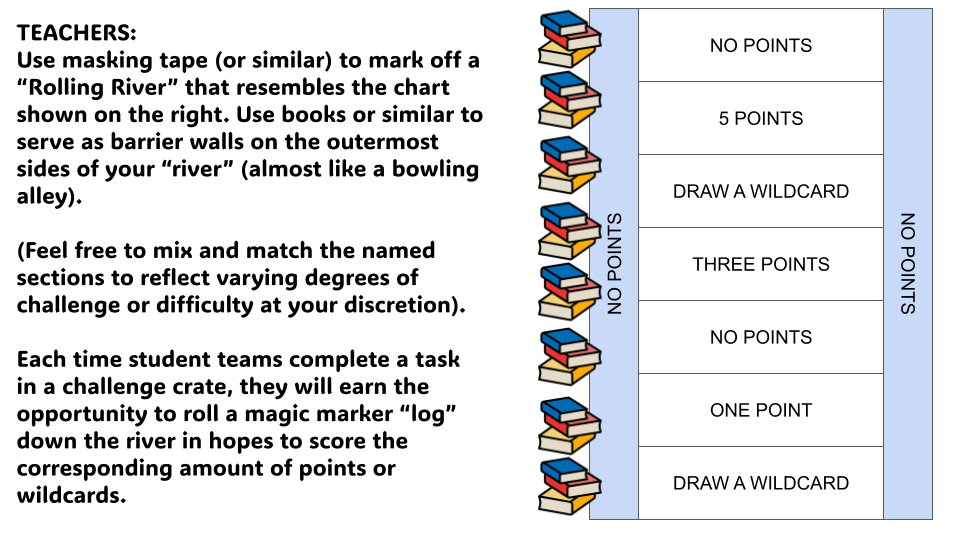
In Lumber Jacked, for example, students draw a “challenge crate” (a.k.a. task card stashed in an envelope), complete the task, and then call the Foreman (that’s you!) over to check their work. If they’ve met your expectations, they earn a chance to roll their whiteboard marker “log” down the Rolling River scoreboard.
It’s fast. It’s fun. And it reinforces the learning without needing any technology whatsoever.
No data entry.
No software.
No hidden dashboard.
No special setup.
Just: Do a task ? Get it checked ? Take a turn ? Repeat.
4. The cycle continues until time runs out.
Teams complete task after task, each one reinforcing the content — and if a group draws the same station more than once, that’s not just “okay”… that’s the magic. These tasks are intentionally open-ended and infinitely repeatable so that every return visit becomes a chance to level up the learning.
And here’s the best part…
A second (or third!) draw of the same task envelope doesn’t just mean repeating the same work all over again — it means going deeper! This organically gives students the chance to level up their learning as they provide…
- richer detail in a drawing
- stronger sentences in a writing task
- more nuanced connections in charting activities
- bigger, more ambitious builds using even the simplest of supplies
- sharper questions that reveal deeper thinking
- more creative representations in nearly every manner of action or expression you can imagine
Each repeat becomes a fresh opportunity to stretch thinking, refine ideas, and push creativity even further. That’s the power of playful learning at its best.
You guide, support, celebrate, and course-correct as needed. The whole experience stays structured enough to run smoothly, yet flexible enough to invite curiosity, challenge students appropriately, and adapt beautifully to any content area.

But Do I Need to Enter Data Somewhere?
Nope — not ever.
This is one of the most common questions we hear from new EMC² teachers. Because our activities are so customizable, it’s easy to assume there must be an app where you “input” content or program the game.
Because the true magic of EMC² Learning is that every playful lesson is powered by relationships, not software.
Everything happens:
- Live
- Hands-on
- Face-to-face
- In the classroom
- With your students
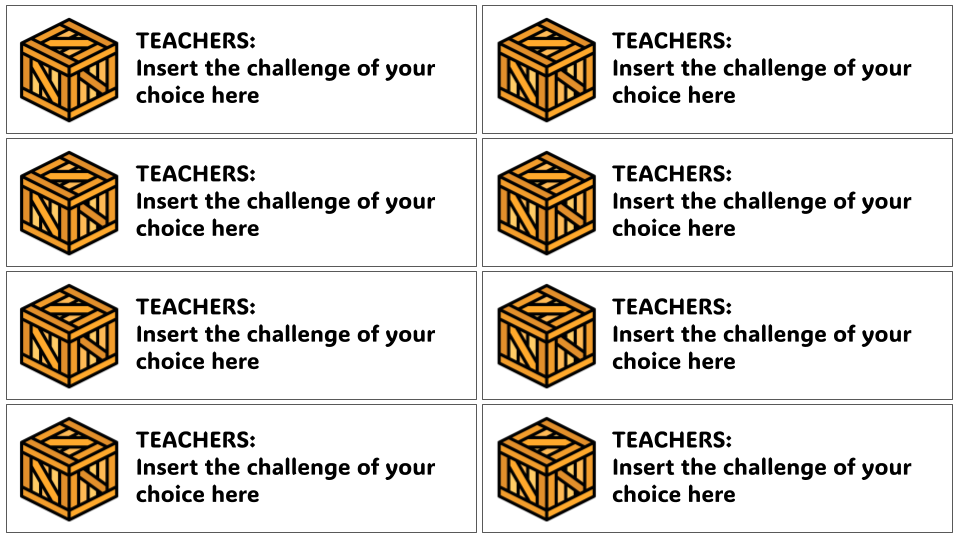
For Lumber Jacked, the only thing you need to prep is the list of tasks you want your students to complete. Just type them onto the slips we’ve included on slide #7 of the resource download. We’ve even included dozens of sample tasks as inspiration to get you started right away.
And if you still feel stuck? You’re not alone — and we’re right here.
Once you see a single EMC² activity in action, everything clicks. The platform was designed to feel intuitive, playful, and teacher-friendly — and we’re always just a message away if you need help:
Want us to recommend a great starter resource? Need ideas for task prompts? Looking for a walkthrough of one of your favorites? Curious how to adapt something for your grade level or subject?
Just reach out. We’re teachers too, and you never need to figure this out by yourself.
The EMC² platform is a creativity engine built for busy classrooms. With a little practice, you’ll be running these activities with the confidence and ease of someone who’s been doing it for years.
Until then? We’ll be right here, cheering you on, answering questions, and helping you turn everyday lessons into unforgettable moments of playful learning.
Let us know how we can help — we can’t wait to see what you create!
The activities featured in this blog post are just a handful of the 1,100+ resources available and on their way to arrive shortly in the EMC² Learning library. This entire library is available to all members with an active Engagement Engineer or Engagement Engineer PLUS account, and is included with your annual site membership. We hope you’ll consider joining us as an Engagement Engineer to unlock a full year of site access. For complete details including our exclusive limited time offer for annual site membership, click here.